Consulting
Training for your own dog
You already have a dog and want it assessed, a behaviour corrected, or to take it further. We work with any breed.
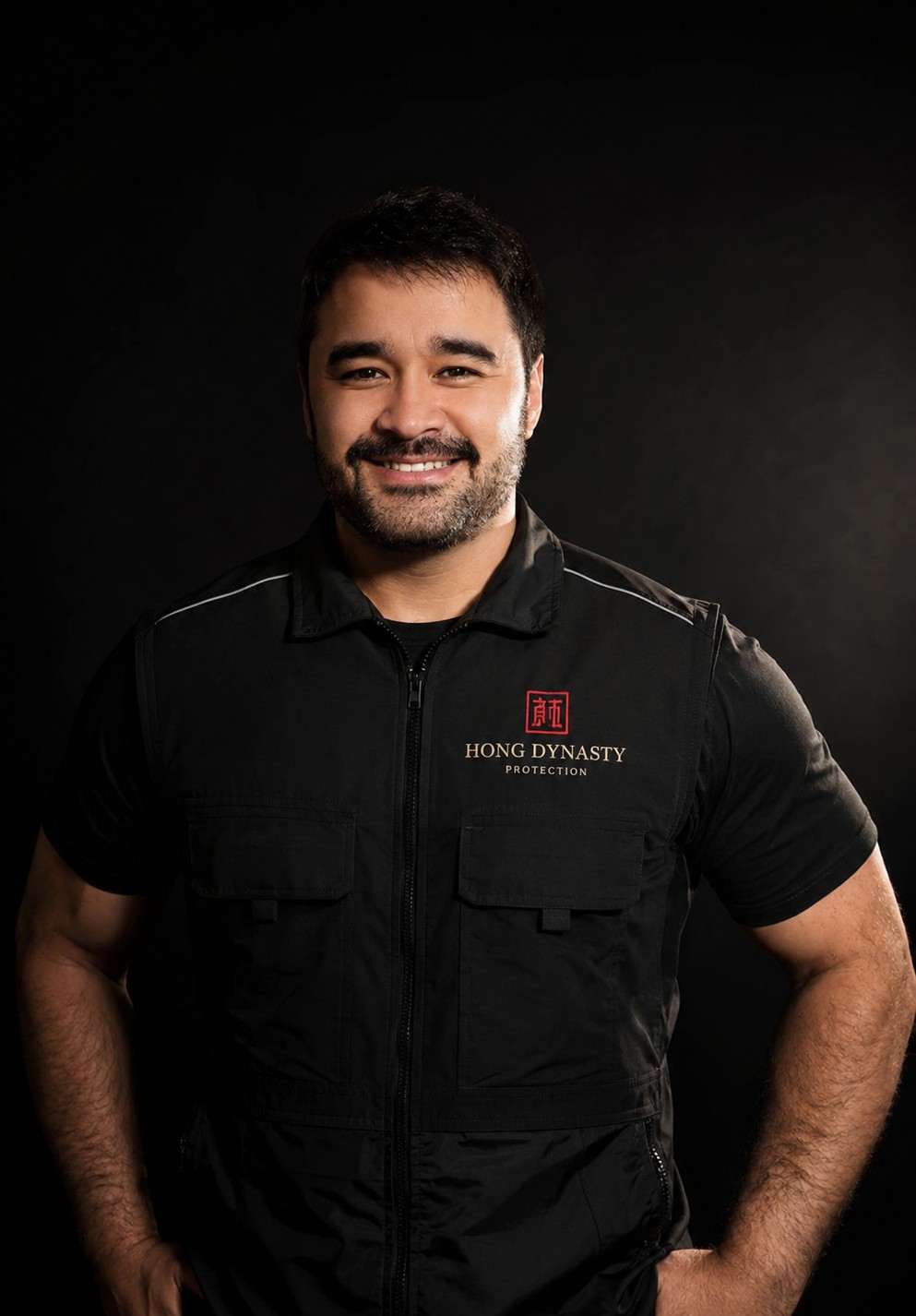
Diego SilvaTrainer, and the person responsible for the methodology behind all training at Hong Dynasty Protection.
The initial assessment is free and serves one purpose: to tell you honestly whether your dog has the profile for what you want. When it does not, we say so on the spot. Hearing no now is cheaper than finding out later.
The methodology
Biting is the easy part
The hard work is the other one: teaching the dog to decide when not to bite, and to stop the instant it is told to stop. That is where the method lives.
Diego designed and runs the Hong Dynasty training protocol. He decides which dog enters protection work, at what pace it progresses and, when that is the answer, which dog does not progress at all. No dog moves up a level without going through him.
The method starts from a reversal. Much of the market teaches a dog to bite and then tries to teach it to stop. Here the order is the other way round: first the dog learns to live indoors, to be around people and to obey under distraction. Protection only comes after that. A dog that will not release on command is not a trained dog, it is a problem with a pedigree.
In practice that means marking the right behaviour clearly at the instant it happens, rewarding with what that particular dog actually wants, and using correction sparingly and only once the dog already understands what is being asked. Drive is channelled, never stirred up with nowhere to go. And every step forward respects the animal’s threshold: it only meets new pressure once it works steadily under the pressure before it.
Diego’s speciality is the hardest and least showy part of the craft: discrimination. Getting the dog to tell the cleaner from the intruder, a child’s hug from a stranger’s advance, the building site next door from a noise inside your own yard. It is years of work, done in real scenarios, with decoys the dog has never met and places it has never seen. It is also what separates a protection dog from a dangerous dog.
A good dog is not the one that bites well. It is the one that does not bite when it does not need to, and is ready all the same.
Areas of focus
- Temperament assessment and drive reading
- Foundation work and socialisation in the critical period
- Obedience under distraction and off-lead work
- Intent discrimination in real scenarios
- Bite inhibition and release on command
- Living with children, staff and contractors
- Preparing the owner and the family at handover
- Recertification and maintenance across the dog’s life
- Temperament and drive assessment, at no charge
- Basic and advanced obedience, residential or at your home
- Correction of a specific behaviour
- Puppy preparation
- Annual maintenance and recertification
Protection work is offered only for dogs we have trained ourselves. We do not train protection on someone else's dog, because we cannot answer for a genetic background and a history we did not follow.